Showing posts with label death. Show all posts

Sunday, June 23, 2019

Passages


Something strange happens with age.

Someone's life interacts with yours once, twice, or more during your youth. Then you and he (or she) fall out of touch for many years, and you only find cause to think of them on rare occasions.

But one day you discover that this person who's not a current part of your life died years ago, and against all logic, you still feel an incredible sense of loss.

I've been through this twice in the last couple of months.

Once concerned a woman I'd known all through our school years, but hadn't seen since 1974. She died a few years ago but I only learned of it two or three weeks before today.

Another concerned a man I'd come to know when I owned my comic shop. I hadn't seen him in twenty years or so, and I recently discovered he died almost that long ago.

In both cases, I felt that incredible sense of loss that I mentioned above.

If I may be allowed to get a bit dramatic here, let me just quote Jim Starlin and say "Never again will the stars shine as brightly for me."

Thanks for your time.

Thursday, May 23, 2019

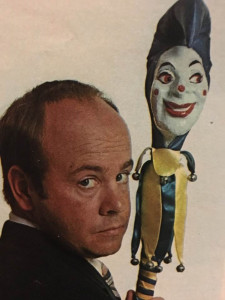
Tim Conway, 1933-2019, Doris Day, 1922-2019, R.I.P.


I was incredibly saddened to hear of the May 14th death of comedian Tim Conway, at the age of eighty-five. (Although you'd never know it by the fact that it took me more than a week to get this post written and... errr... posted.)

My very first exposure to Mr. Conway was when he played Ensign Charles Parker on the World War II sitcom, McHale's Navy (1962-1966).


I then began following his TV career faithfully, although at times, it seemed like I was one of the only television viewers to do so.

 After McHale's Navy, the shows Conway starred in throughout the 1960s and into the 1970s all died fairly quickly.

From McHale's Navy, Conway went to Rango (1967), and then The Tim Conway Show (1970).

Rango (1967)

With Joe Flynn, who had played Captain Binghamton on McHale's Navy.
Both were regulars on The Tim Conway Show (1970).

Next, also in 1970, came The Tim Conway Comedy Hour. Maybe they felt that the word "comedy" would help sell the show as a... well... as a comedy? It did not. Personally, I enjoyed it. (Of course, I wasn't quite fourteen...) It had comedian Art Metrano as "The Tim Conway Orchestra" and a pre-All in the Family Sally Struthers as "The Tim Conway Dancer." Yes, dancer, not dancers. Folks, ya hadda be there!

The Tim Conway Comedy Hour

Conway joined the cast of Carol Burnett's show, which was imaginatively titled The Carol Burnett Show, during its 1975-1976 season, and he certainly seemed to have found his niche. He became well-known for making his fellow cast members -- primarily Harvey Korman -- crack up during filming, but Conway's comedic talents far surpassed that simple bit of business.


Conway's many regular characters on The Carol Burnett Show included Mr. Tudball (Carol played his incompetent secretary, Mrs. Wiggins)...


Mickey Hart in "The Family" sketches...


...and "The Oldest Man," who took forever to do anything or get anywhere. He even took a full minute or two to fall down a flight of stairs! Tim played the Oldest Man in countless scenarios.


One of my favorite Conway sketch roles was in an updated version of "Cinderella," where Tim played pop star "Elfin John!"


During the 1970s and into the 1980s, Conway did several films, many for Disney, and some (both Disney and non-Disney) co-starring Don Knotts.


After The Carol Burnett Show ended in 1978, Tim went on to do other TV shows, and began appearing as a diminutive character named Dorf.


I'll confess that I sort of lost track of Conway's career after The Carol Burnett Show, mainly due to the fact that my TV watching was rather limited during the late seventies and throughout most of the eighties. Having said that, the enjoyment he gave me throughout my youth cannot be measured.


* * * * *


Unfortunately, this is one of those "kiss of death" things which I often half-heartedly joke about on this blog.

A little over a week ago, on a Friday night, I was going through my hall closet, a closet which contains mostly hardcover and paperback books, and numerous magazines. I removed several items which I plan to have signed by various comic book personalities and TV/movie celebrities at this summer's TerrifiCon in Connecticut. I also "pulled" a few that I decided to part with by (hopefully) selling them at the flea market where I set up every Sunday.

One of several books I brought to the flea market was a biography of singer, actress, and animal rights activist Doris Day. I placed the book out for sale on Sunday, May 12th. She died the very next day, aged ninety-seven.


I wasn't very familiar with Doris Day's singing career until I was an adult. I did know her as a movie and television actress.

My favorite film of hers was 1961's Lover Come Back, where her co-star was Rock Hudson, and their supporting cast included Tony Randall, Edie Adams, Ann B. Davis, and Donna Douglas, and Tim Conway's old foil, Joe Flynn!


Her TV series, The Doris Day Show (Where do they get these titles?!?), was notorious for being plagued by constant cast and format changes throughout its five-year run.


Although I always enjoyed her work, I was never a huge fan of Doris Day's, hence the brevity of this so-called tribute, but thought her worthy of inclusion here, especially to make yet one more reference to that whole "kiss of death" syndrome which keeps occurring on this blog.

Thanks for your time.

Thursday, March 21, 2019

Tom K. Ryan, 1926-2019, R.I.P.


Today's post will be remarkably short, considering my usual wordiness and tendency to tell you all sorts of trivia about a celebrity and his or her work.

Cartoonist Tom K. Ryan, known for the 1965-2007 strip Tumbleweeds, has passed away.

I know very little about the man himself. I remember encountering Tumbleweeds in the newspaper, and buying a handful of the paperback books collecting the strip. (I bought tons of those in the late sixties and early seventies, featuring every thing from Peanuts, to B.C., to Blondie...)


Tumbleweeds' cast of characters was incredibly varied and, as befits a humor strip, hilarious. Here are just a few examples, and that's going to do it for this entry!


All I can add to that is... it gave me many hours of enjoyment!

Thanks for your time.

Monday, February 25, 2019

Peter Tork, 1942-2019, R.I.P.


Yes, I know it's been a very long time since I've been posting my celebrity tributes on a regular basis. I think the only two since Lord-knows-when were Steve Ditko in July, and Stan Lee in November. And believe me, there's a whole post in itself explaining why I haven't done many lately, but let's cut to the chase and just say it's a combination of available time and an urge not to "bury" my posts by blogging too often.

Enough of that.

I was kinda surprised to hear of Peter Tork's passing the other day. I was a fan of Mr. Tork and the other three of the Monkees, the so-called "pre-fab four" whose popularity rivaled that of the Beatles for a while. It could be arguably stated that by 1966, the Beatles' appeal was to those with slightly more sophisticated tastes, but that's a discussion for another time. And for someone else's blog, for that matter.


I'll make a simplistic statement here: Of the four Monkees, Peter Tork and Mike Nesmith considered themselves to be actual musicians, while Davy Jones and Micky Dolenz seemed to think of themselves as primarily actors, at least at first. None of the four were allowed to contribute anything in the way of instruments on the Monkees' first two albums. But Tork, who was a versatile musician (to say the least), was surprised and resentful toward the attitude of the Powers-That-Be. From their third album on, the Monkees insisted on playing their own instruments.


A few years ago, when all four of the Monkees were still with us.

I only have two personal Monkees-related anecdotes to share here. (Three, if you count the fact that I saw the Monkees -- minus Mike Nesmith -- in concert during their mid-1980s Reunion Tour.)

1. Many years ago -- 1982 or 1983, if memory serves me correctly -- I was still actively appearing with local bands, or if not, looking for my next one. At that time, I was envisioning forming a band all my own, which would play primarily oldies rock'n'roll and blues. I even came up with a great name, a unique name, a name I liked so freakin' much that  I didn't tell anybody what it was. I was saving it.

A few years after I'd come up with this incredible name, the Monkees performed on some TV show. Whichever program it was escapes me now. After the Monkees played, there was a brief interview segment where Peter said that his own band was the Monkees' opening act. The band's name? Shoe Suede Blues.

  
Need I even bother to state that The Shoe Suede Blues Band was the very name that I had come up with, quite a while earlier? I thought not. Damn! What were the odds?!?


2. Somewhere around twenty years ago, a bunch of people who lived in my apartment building were congregated on two back porches, commiserating and having a few beers. I mentioned (for some reason) that of all people, Jimi Hendrix had very briefly been the Monkees' opening act in 1967, before Hendrix had made a name for himself.

A guy named Don said "Hendrix! Hendrix was sixties!"

"Yeahhhh, and so were the Monkees," I said.

"The Monkees were in the seventies."

"Their TV show premiered in September of 1966," I stated.

Don continued to argue.

Well! Although the internet existed when this conversation took place, none of the people assembled that day had ready access to it. However, I had a Hendrix biography -- 'Scuse Me While I Kiss the Sky: The Life of Jimi Hendrix by David Henderson -- somewhere in my apartment, plus the latest edition of a book with a slightly longer title, The Complete Directory to Prime Time Network and Cable TV Shows, 1946-Present by Tim Brooks and Earle F. Marsh!

I ran -- okay, walked -- to my apartment and went to look for the two books. I couldn't find the Hendrix bio, but I found The Complete Directory in no time. I brought the volume onto the porch, and read the information aloud about when The Monkees premiered on NBC, which was on September 12, 1966.

  
Don's reply was "Oh, I don't care what it says in a book." Wow. Then how can anyone ever prove anything, I wondered, but I didn't pursue the matter any further. What would have been the point? When someone clings so firmly to their ignorance, who can dissuade them?

It kinda reminded me of the whole "Ms." incident that I talked about here.

Anyway, I've often heard Peter Tork's on-air persona described as the "funny" or "goofy" member of the cast of The Monkees, but that's like pointing at a photo of Groucho, Chico, and Harpo Marx and naming any one of the three as the "funny" one. All of the Monkees (on the TV show, anyway) were goofy. It was a goofy show... as it was supposed to be.

A slightly more serious shot of Peter than what we usually saw during the Monkees' heyday.

Thanks for your time.

Wednesday, November 21, 2018

STAN LEE, 1922-2018, R.I.P. ~~ A "Comical Wednesday" Post


I've had several friends contact me recently about the death of yet another comic book legend, the one and only Stan Lee. Most assumed I'd already heard, while a few simply asked if I had. But all of them know that I'm a fan of comic books (and comic strips as well), not to mention pop culture in general, and so they knew that his death must have affected me in some way.

How could it not?

The fact that most of these friends were not comic book readers now, nor in many cases, ever, says quite a lot about how important Stan was in the creation or co-creation of countless well-known characters that have indelibly etched themselves in our world's pop culture.

Heh. Reading that last paragraph, I'll admit it sounds rather overstated. But it's not.

 Stan with his wife Joan, who predeceased him.

 Stan with unidentified fan. Heh.

Stan in front of many books which he wrote, as well as many he did not.

Stan and Roy Thomas.

Since I'm not about to launch another lengthy multi-parter like my recent Insect Man series, I will not even attempt an actual biography of the man who gave us –- either singly or with one or more collaborators –- such heroes, villains, teams, and supporting characters as Spider-Man, Thor, the Hulk, Iron Man, Daredevil, the Fantastic Four (Well, three of them, anyway!*), Nick Fury, the Black Panther, the Avengers, the Inhumans, Dr. Strange, Dr. Doom, Dr. Octopus (Uhhh, what the %$#!& is the fixation with doctors here?!?), the Green Goblin, Magneto, Loki, Baron Zemo, Groot (yes, that Groot), Kraven the Hunter, Kang, the Mandarin, the Puppet Master, the Lizard, the Sentinels, Stilt Man, the Owl, Gwen Stacy, Rick Jones, Wyatt Wingfoot, Aunt May Parker, Mary Jane Watson, Ant Man, Odin, the Mole Man, Mr. Hyde, the Grey Gargoyle, the Watcher, and scores of others, including a monster called – I swear – Fin Fang Foom! And I just gave you a partial list of Marvel characters from the 1960s!

(Over the next few weeks, I do plan to write a few more blog posts about Stan... But none of them will be labeled as Part Two or Three or whatever. Just more stand-alone articles.)

By the way, two quick notes here about that list above:

1. When I say Lee created or co-created Thor, Loki, Odin, and other characters (unnamed here) who obviously came from Norse mythology, I only mean that he had a hand in the crafting of Marvel's versions of these characters.

2. You may have noticed the admission of one major Marvel hero, one major Marvel villain, and even one major Marvel hero/villain, namely Captain America, Cap's bitter enemy the Red Skull, and Prince Namor (better known as the Sub-Mariner) respectively. Well, before Lee even came on board at what was then (“then” being the late 1930s and early 1940s) called Timely Comics, Subby was created by artist/writer Bill Everett, and both Captain America and the Red Skull were created by the team of Joe Simon and Jack Kirby. In fact, the teen-aged Stan Lee's very first story was published in Captain America Comics #3!


Anyway, as told here, I hadn't been reading very long before I discovered Marvel Comics. In other words, I hadn't been reading very long before I discovered Stan Lee and his writing. It may not be apparent in the stuff I write, but his writing was an inescapable influence on my own, and, dare I say it, some of the actual attitudes that I live by to this day.

My first Marvel comic.

I'll bet Bill Maher would have gotten a chuckle out of my saying that Lee's writing influenced me as a person. Maher recently wrote a brief but highly controversial article about Stan Lee, which many have interpreted as a personal attack on Stan. I've read it – and no, I'm not going to link to it – and I see it more as an “attack” on those who, like myself, lament and make a fuss about the passing of someone who created stories purportedly meant for kids. Maher's piece seemed to make fun of all the men (and women) who still enjoy so-called “kid stuff” in any way shape, or form.

(I wonder if Bill Maher, as an adult, has ever visited Disneyland or Disney World? I do know that he frequented Hugh Hefner's Playboy Mansion, which was pretty much the same thing.)

If you've bothered to follow any of the obituaries flooding the airwaves and the internet, you're reading articles which give the man either too much credit for his accomplishments, or not enough. It depends on the sources various writers turned to in order to write their articles, and in some cases, whether or not said writer had a particular “angle” he or she wanted to espouse.

You're probably going to read (or maybe you've already read) that Stan was a prolific genius who created practically everybody who appeared in the Marvel Comics of the 1960s. On the other hand, you may hear that he was just a glory-grabbing company man who signed his name to everything and took credit for the hard work mostly done by artists like Jack Kirby, Steve Ditko, Dick Ayers, Don Heck, and so many others.

Neither extreme is true, of course. Such black and white portrayals rarely are. And a lot of comic history is uncertain, relying on the memories of participants in said history whose memories may be faulty. (Stan himself always said he had a bad memory.) Also, most of the men and women who created comics in the Golden Age and even early Silver Age are now gone.

Two or three years ago, I had a conversation with my friend and former writing partner, Skip Simpson, in which Skip informed me (and I'm paraphrasing, of course) that “Stan Lee is so over-rated. All he did was write dialog for the stories and characters Marvel's artists created. Then he took most of the credit.”

Well, forgive me a moment of arrogance, but my reply was basically along the lines of “You've read one book about the entire history of Marvel Comics, and you want to tell me some 'new' details about Marvel and Stan Lee? Really? Seriously?” (And yes, I even discerned which book Skip had read, but I'm not going to link to that, either!)


Long before he became the guy who appeared in all the Marvel films, and even before Stan became the figurehead and public “face” of Marvel Comics, I knew Stan the writer/editor. (Okay, when I say “I knew Stan” I'm not being literal. Never met the man. But by reading so many of his stories – hundreds, at least – I felt like I kinda/sorta knew him, at least a little bit.)

During my so-called formative years, I experienced and/or read about the little innovations Stan Lee brought to the comic medium as a writer and editor. Just two examples, then I'll shut up for today:

1. Back in the mid-1960s, Stan had to personally communicate with Marvel's printer so they would stop coloring Gabe Jones (an African-American who appeared in  Sgt. Fury and his Howling Commandos) like just another Caucasian. He also used Gabe (and other characters from minority groups) as the focus for various stories that spoke against racial prejudice, religious intolerance, and other forms of ethnic-based hatred. More on that some other time.


2. Stan fought the Comics Code Authority in the early 1970s because they refused to permit any mention of recreational drug use, even to say that drugs were bad. Stan asked, "Then how do we reach these kids?" and when the CCA stood their ground, so did he. He published a trio of Spider-Man stories without that precious Comics Code seal of approval.


Over the years, eclipsed by the image of the ever-smiling company mascot (if I may use the term “mascot” so cavalierly) who didn't take himself too seriously, some of Stan Lee's more courageous stands have been downplayed, if not outright forgotten.

Not by me.

Thanks for your time.

Goodbye, Stan.

*Stan Lee and Jack Kirby co-created Mr. Fantastic, the Invisible Girl (later the Invisible Woman), and the Thing. However, the Human Torch was created by Carl Burgos... although “human” was a misnomer for an android superbeing! The Torch's 1960s Johnny Storm persona was developed by Lee and Kirby.

Related Posts Plugin for WordPress, Blogger...