Sunday, November 9, 2008

The Once and Future AERO, Chapter Two!


Part Three ~~ The 1980s, again!

It occurred to me earlier today -- "today" meaning the day I actually wrote this section, not the day I posted it -- that when I wrote "I 'filed' the two pages [from Dick Ayers] somewhere and more or less forgot about them... For about six years, anyway... " I was wrong.

Sometime in either 1987 or 1988, I contributed a brief article entitled "He Who Rides the Night Winds" to That's Entertainment's in-store newsletter. It was a history of the Western Ghost Rider character -- not the flaming-skulled motorcyclist -- that had been published during the 1950s by a comic company called Magazine Enterprises, and then in the 1960s by Marvel Comics. This is the same character that has been referred to since then as the Night Rider, the Phantom Rider, and the Haunted Horseman!

Anyway, I used that article as an excuse to contact Dick Ayers, ostensibly for background information on the character's history and incarnations. Dick was more than gracious in answering my fannish questions.

Now we can proceed to...

Part Four ~~ The 1990s

Somewhere around 1993, five years after I'd ended up leaving That's Entertainment, I began going through an incredible period of creativity. Not necessarily productivity, I hasten to add. But the ideas themselves wouldn't stop coming.

I came up with a list of over two dozen concepts. Most of these were envisioned as comic books. And not just because I happen to like comic books, I'll admit.

Y'see... I've never been a fan of the kind of prose writing which wastes a page or two describing the color and texture of somebody's freakin' carpet. If I'm writing a story, and take the time to mention that the curtains in somebody's kitchen are old and ragged, there's a purpose behind my mentioning it, even if said purpose is not immediately apparent.

For that reason -- and let's call it... ohhh... "laziness?" -- I was attracted to the comic book format for writing my stories. If I wanted my characters, Billy and Bobby, to be in a kitchen, all I'd have to do is write "Billy and Bobby are standing in the kitchen," basically. Then it'd be the hard-working artist's job to draw a whole kitchen, complete with kitcheny-type stuff, and to put Billy and Bobby in it.

And the artist could also worry about what the freakin' curtains looked like, if there even were any curtains! That'd be up to him or her. But, once again, if I mentioned in my script that "the kitchen curtains are old and ragged," it'd be for a reason.

It was at this point that I realized how Stan Lee was able to write, like, 47 Marvel Comics titles a month during the glory days of Marvel Comics. He'd plot (or co-plot) a story, and then tell an artist -- like Jack Kirby or Steve Ditko or Dick Ayers or Don Heck or whoever -- what he wanted. Then he'd add captions and dialogue to whatever came back to him.

Lucky guy. But I digress.

One of my two-dozen-plus concepts was a comic book title called "Two Heroes Comics."

I don't remember what gave me the initial idea, but "Two Heroes Comics" was going to feature... well... two heroes. Two different heroes. But both would have the same superheroic name. Aero.

Oh, hell, I'll just reprint what I wrote in my list of concepts:


Two Heroes Comics will consist of two separate features, both named “Aero.” (The title was originally planned as a flip book, but it seems that people are getting sick of those.)

“Aero,” a/k/a “Kid Aero,” or the “Silver Age Aero,” (but never in the actual stories) runs from 1963-1974.

“Aero II,” the “Modern Age Aero,” takes place in modern times (therefore, 20-30 years after the stories in “Kid Aero”), in the same “universe” as “Kid Aero.” It’s a much more technologically-based series. Flashbacks will reveal that Aero II originally began “life” as yet another superhero, the Raven, who almost died in the line of duty. His current powersuit also serves as a life-support system for the recovering man within it.

The fact that “Aero II” and “Kid Aero” live(d?) in the same universe will hopefully raise many questions in the readers’ minds: “Is ‘Kid Aero’ still alive?” “If so, will the two Aeros ever meet?” (If they do, there’ll only be about 10-15 years’ difference in their ages, due to the fact that “Kid Aero” was a superhero when he was... well, a kid!) “Will ‘Kid Aero’ sue ‘Aero II’ over the name?” Several major points in the “Aero II” series are “set in cement,” but there is a lot of leeway during “down times.”

You probably noticed that there isn't a hell of a lot of info on the "Kid Aero" series. And you may have also guessed why, but I'll get back to it.

My concept for "Kid Aero" was simple. It was based on a "what if" idea, namely, "What if I had decided to become a superhero on the day of President John F. Kennedy's assassination?"

You have to understand. Kids in those days had two kinds of heroes.

There were the fictional heroes. On TV, for me, those were characters like Zorro, and The Lone Ranger. And in the comic books, there were superheroes like Superman and Batman.

In real life, our heroes were astronauts, and presidents (past & future).

Even at that tender age, I knew instinctively that Zorro, The Lone Ranger, Superman, Batman, and all those like them... They were always going to "live" to see the next issue, or the next episode.

And, years before the near-tragedy of Apollo 13, or the fire that killed the Apollo 1 astronauts, those who were my age never even considered the possibility of anything happening to the heroes of our country's space program.

But someone shot -- and killed -- our president!

Kennedy's death shocked and saddened people literally all over the world. It certainly had an effect on seven-year-old David.

So, to repeat: Thirty years later, I wondered, "What if I had decided to become a superhero on the day of President John F. Kennedy's assassination?"

Well, this is -- and was -- the "real" world. I didn't become a superhero, of course, at that time or any other.

But Charlie Farrell -- my fictional alter ego -- did.

And unlike Bruce Wayne, who promised himself at a tender age that he would train himself for a war on all criminals, a war he began in young adulthood under the name of "Batman," Charlie Farrell said at seven that he was going to become a superhero immediately.

At seven.

What a jerk.

Needless to say, from that point, Charlie's life (in the fictional world) and mine (in the real world) took increasingly divergent paths.

And that was the concept behind "Kid Aero."

My series would follow Charlie Farrell from childhood into young adulthood, as he became less of a joke, and more of a real hero. Eventually, he would have a really cool costume, but at first...

Hm. At first, what would "Aero" wear? It would have to be something hastily-thrown together, of course.

Something like... oh...


Something like that, perhaps. Yeah!

(So. I still have absolutely no idea who I was supposed to be in that photo. However, revisionist history being what it is, I now know who he was. If that makes any sense.)

Now all I needed was an artist. Someone truly professional. Someone whose art would mesh with the nostalgic, 1960s feel I wanted for the strip. And if it were someone who'd actually worked in comics back then, someone with "a name" among comics professionals, so much the better...

Okay, you're all with me here. Of course I thought of Dick Ayers.

And to make an already-long story a bit shorter than I might -- if I were ever to allow myself such an indulgence -- let's just say that when I approached Dick with the offer... he accepted. (And that's why the above description of "Two Heroes Comics" gave such short shrift to "Kid Aero." Those concept descriptions were designed to woo artists, and "Kid Aero" already had one.)

I explained to Dick that since I'd created the character, and even the visual, in my way, I owned the character outright. However, I had absolutely no intention of perpetuating some of the underhanded, crappy tactics which had screwed comic creators out of royalties, reprint rights, etc. since the comic book business had begun.

Basically, I told Dick that:
  • The fact that I owned Aero would in no way influence my percentage of the money paid by whichever publisher decided to give Aero a shot. Dick would get a more-than-fair percentage of an artist's page rate, where I would "only" get the writer's page rate.
  • Dick would keep all of his original artwork. That's a given nowadays, or at least, it sure as hell should be!
  • Dick would get 50% -- in other words, he'd be paid as if he were Aero's co-creator -- of any licensing "deals" involving Aero, should he become a successful character. 50% of the option fee for movies or television (if any). 50% of the toy rights (if any). 50% of the video game licensing fee (if any). 50% of the profits from the role-playing game licensing fee, the greeting cards, the cloisonné pins, the trading cards, the Halloween costumes, the breakfast cereal, the inflatable "love doll," and so on!
  • These points, and presumably more in a related vein to be determined later, would be expressly stated in a contract between Dick and myself, to be drawn up and signed before anything was signed with a prospective publisher.
And if I changed my mind somewhere before drawing up and signing that contract? Well, then, Mr. Ayers could simply walk! Not only would that screw up my deal with the publisher -- after all, Aero was being sold with Dick Ayers' involvement prominently featured -- but what publisher would want to enter into a business relationship with someone whose own people wouldn't stay with him?

So, this being a work-for-hire for lack of a better term, I of course had to front Dick the money for the artwork, against any future reimbursement by a publisher. Dick suggested that instead of having him draw the entire seven-page Aero origin story, I should submit the concept to publishers by attaching the full script to only three pages of amazing Ayers art.

To paraphrase George M. Cohan, I thanked Dick, and my wallet thanked Dick!

I sent Dick my script, along with about 47 pages of photocopied photos, mostly of myself (a/k/a "Charlie Farrell"), my Uncle Eddie (a/k/a "Uncle Ted"), and a few cover shots from a 1940s comic book called "Captain Aero."


And... I waited.

Just like you have to wait another week to see what I saw when the large manila envelope arrived from White Plains, NY.

Thanks for your time.

Next time: You'll get to see what I saw! Three never-before-published pages of Dick Ayers artwork!

Sunday, November 2, 2008

The Once and Future AERO, Chapter One!

David M. Lynch's First Rule of Writing: Never throw anything away.

Part One ~~ The 1960s

The very first character -- a superhero --- that I remember creating was "Lobster Man," a rather unimaginative sort who popped into my head when I was about five or six years old. Someday, I'll tell you more about him. But not now.


  • The very first story spawned by my young mind was the now-painfully-recalled tale of "The Grandson of Dracula," which made its almost-debut a year or two after Lobster Man's creation. Only a few paragraphs of the story were ever actually written down (by my mom, no less), and only parts of it were plotted, as well. And if you're a glutton for punishment and want to know more about the story, all I can remember at this late date are two plot points:

  1. The main character's father -- the Son of Dracula, natch! -- was briefly mentioned at the beginning of the story. He was an American soldier in World War II, who was unceremoniously staked right in his foxhole by another American soldier who'd discovered his true identity. Swear to God.
  2. The climactic battle which resulted in the death of Drac's Grandson -- I don't recall ever having given him a real name -- took place atop the uppermost tracks of a freakin' roller coaster. Again, I swear to God.
When I was really young, I would often act out the stories I created in my warped little brain. I seldom took these sessions all the way to the point of dressing as the characters, but if my memory serves me correctly, I did end up dressing as the Grandson of Dracula, wearing a costume comprised of:
  1. A Frankenstein mask (Of course it made no sense, but my "costumes" were assembled from whatever I had around the house!).
  2. A pajama top designed to look like a gaudy sportcoat (It had wide red, white, and blue horizontal stripes, and IIRC, red lapels.).
  3. A wooden ski pole as a "weapon." I don't know why I used a ski pole rather than one of the zillion toy guns I owned. Maybe it was more in keeping with the superheroes, who didn't kill. Captain America had a shield, not a gun. Thor had a hammer, not a gun. And so on.
  4. Lord knows what else.
Anyway, what I'm trying to say in my typical roundabout fashion is that I don't know who or what I was supposed to be on the day the above photo was taken, but it sure as hell wasn't Lobster Man or The Grandson of Dracula.

It wasn't Red Raven, either. He came very slightly later, when I was about seven. (Yup, that's another tease, for another time. Sorry.)

I went through a lot of phases when I was a little brat kid. I had to, as a sort of coping mechanism for the fact that I didn't have too many neighbors my own age. What I did have was a sister who was six years my elder. She and I didn't play together very much. I remember two games we played a lot, however:
  1. "Jocko" was what we called the game where my sister played a young girl who owned a monkey named Jocko. I, of course, was Jocko. Yay.
  2. "Chicken Hawk" was what we called it whenever we would ride our horses -- real horses, I should add -- to various imaginary farms, warning all the farmers to lock up their chickens because the dreaded chicken hawks were coming! Swear to God. Damned chicken hawks never even showed up. (Chickenshit was more like it, apparently!) And obviously, since it was our game, they could have shown any time we wanted them to, and I dimly recall at least one time when I suggested to my sister that such a confrontation was necessary for the sake of an exciting storyline... but no. She controlled these stories. No wonder I wanted to be a writer as I grew older, so I could be in control of the story.
But I digress.

Something else that I had, which was ten times better than neighbors and a damned sister any day of the week, was 4.7 acres of mostly fields, with some surrounding woods... added to an over-active imagination.

When I wasn't in the house watching television or reading, I was usually outside in the field -- my father often instructed me to "go outside and play with yourself" [sic], which was about as racy as the humor got in my house during the sixties -- and that gave me leave to play on one of the two huge wagons we had on our property.

When I say "wagons," I'm not talking about the "little red wagon" variety. Nope. We had two full-sized wagons. One was similar to the old "covered wagon" you'd see in all the TV and movie Westerns... but without the cover -- or metal "ribbing" -- itself. The other was a "tilt-cart," kind of a forerunner of the dumptruck. Both were ancient, and starting to rot.

Potential death-traps, in other words. The perfect playground accessories.

There was no such thing as a "child-proofed" anything in my day. I guess they figured that if you survived all the scrapes, gashes, broken bones, concussions, and the like which you were bound to encounter while growing up, it was God's way of showing the world that He'd meant for you to make it to adulthood all along!

(Hey, not bad. I just managed to combine "intelligent design" with evolution's "survival of the fittest" angle.)

But hey, I'm still digressin' my ass off here, so what's say we only stay stuck in the '60s long enough to say that, in reference to the above photograph:
  1. Somewhere in the back of my childish mind, I must have been pretending that the green monster toy -- The Great Garloo, by Marx -- was a gigantic figure in his and my "reality." Otherwise, I would've been a pretty crummy superhero to attack something smaller than myself... and with a damned ski pole as a weapon, no less.
  2. Again, I really have no idea who or what I was supposed to be in the above photo.
Okay, boys'n'girls... Let's jump ahead roughly twenty years. Cuz I can.

Part Two ~~ The 1980s

During the mid-1980s, I was working at a store called That's Entertainment, in Worcester, Massachusetts, which sold comic books, records, sports & non-sports trading cards, role-playing games like Dungeons & Dragons and the like... and just about anything else one could call a collectible. (Can you say "milk bottles," boys'n'girls? Sure you can.) TE's owner (and Jerry Seinfeld lookalike), Paul Howley, was a shrewd businessman trapped inside the body of a "kid" who refused to completely grow up, at least where it concerned things he didn't have to act like an adult to accomplish.

I certainly hope that doesn't sound like an insult. It's meant as the exact opposite. "What I'm trying to say in this awkward way" (Sorry, old Rod Stewart line!) is that Paul generally didn't take things too seriously, which made him a really fun person to deal with, work for, etc.

(One example: Paul used to take a perverse delight in telling people "I sell funnybooks for a living." My personal view was that he purposely used the term "funnybooks" to good-naturedly thumb his nose at those who took the comic book hobby too much to heart. You know, like the oft-seen geek-made-good characters in movies and TV nowadays, who make constant, all-too-serious references to "graphic literature?" That type of person would positively cringe at a term like "funnybooks.")

In fact, it was the last Day Job -- notice I did not use my usual "Crappy Day Job" designation -- which I actually enjoyed going to "work" at.

During my stint at TE, the so-called "black & white boom" -- spearheaded by the fluke success of the Teenage Mutant Ninja Turtles -- hit the comic book market. All of a sudden, anybody who had -- or whose dad had -- two or three thousand dollars to spare could become a comic book publisher. ("Could," and, in far too many unfortunate cases, did.)

Paul and I were both at the store one day, talking about an old TV show we'd both enjoyed as kids during the 1960s. It was a program called The Man from U.N.C.L.E.

According to Paul's recollection of that day, I was the one who asked aloud why none of the comic companies -- many of which had nostalgic licensed projects in the works -- were doing a revival of The Man from U.N.C.L.E. series.

Paul and I suddenly became the 1980s equivalents of Judy Garland and Mickey Rooney, with their old "Hey, kids! Let's put on a show!" exuberance. (I'll leave it to you to decide which of us was Mickey, and which of us was Judy... !) It was decided that That's Entertainment would secure the rights to publish a Man from U.N.C.L.E. comic.

(I am greatly over-simplifying this story! Lord, am I ever! If you want all the dirty details, you can start here.)

Anyway, the decision was eventually made that the U.N.C.L.E. series would feature stories by various writers and artists. Several submissions were... umm... submitted. There was even a sheet of photocopied sketches -- not original art -- and an accompanying cover letter from comics legend Dick Ayers!

Ayers had been working in comics for almost forty years, and had helped usher in the so-called "Marvel Age of Comics" in the 1960s. Personally, I'd particularly enjoyed his work on two Marvel titles, Ghost Rider (a Western character, not the motorcyclist with the flaming skull that came later) and Sgt. Fury and his Howling Commandos.

The "fanboy" within me asked Paul if I could keep the letter and the drawings, and he said yes. I "filed" the two pages somewhere and more or less forgot about them...

For about six years, anyway...

* * * * *

That's all you get this week, gang. Sorry! Next week, Chapter Two (including "Part Three," in my quest to confuse everyone!), which is all about Dick Ayers, myself, and the creation of AERO!

Thanks for your time.

Monday, October 27, 2008

In Search of the White Whale

 Yep, January 3 & 4, 2004. You missed it; I didn't.

Here's an article originally published in a mid-January, 2004, issue of the The Patriot, a Webster, Massachusetts newspaper. ("Oxford" refers to Oxford, Massachusetts, where I lived for over 15 years, during my so-called "formative" period.)

The whale from Pleasure Island's Moby Dick Hunt. I may never know
if my parents brought me there to indulge my youthful fascination for
Moby Dick, or if my obsession began after viewing the beast!

To call the weekend of January 3rd and 4th the culmination of a childhood preoccupation (I hesitate to write “obsession.”) may be phrasing it a bit too strongly, but that’s certainly how it felt to me.

On January 3rd, 1841, the Fairhaven Ship Acushnet sailed out of the New Bedford, Massachusetts harbor. The Acushnet’s crew included a young sailor named Herman Melville, who roughly ten years later published what is arguably the greatest American novel. I say “arguably.” Ken Kesey’s list of the ten best American novels (from The Book of Lists #2) gives Moby-Dick the #1 spot. However, the original Book of Lists includes Moby-Dick as one of “The 15 Most Boring Classics.”

One hundred and sixty-three years later to the day, a good-sized crowd of literary enthusiasts, myself included, gathered in the Lagoda Room of the New Bedford Whaling Museum in order to begin reading this novel aloud, non-stop, in mostly ten-minute increments. This innocent project would end up taking a little over twenty-five hours. Such is and was necessary for a book with a page count exceeding 600, especially considering the labyrinthine writing style common to much of the 19th century’s offerings.

The museum as it looks today!

Readers and spectators alike knew in advance that the reading would take that long, of course. Advance publicity for the event made it plain, which was easy enough for the event’s organizers, as it had been successfully attempted seven times before.

 The museum as it looked when I first visited.

 A postcard I bought when I first visited the New Bedford Whaling Museum
in the mid-1960s. I didn't know it then, but I'd started a tradition!

I don’t recall precisely when and how I first became aware of the epic tome Herman Melville entitled Moby-Dick, or, The Whale. (That hyphen in Moby-Dick, curiously enough, is present only in the title of the book. Every reference to the whale in the text of the novel itself omits it.) It may have become ingrained in my six or seven year old mind when my parents took my older sister and myself to Wakefield, Massachusetts, sometime circa 1962. The trip to Wakefield was to visit a theme park known as Pleasure Island, a relatively short-lived pretender to the Disneyland throne.

However, Pleasure Island’s mascot, as it were, was not a falsetto-voiced, anthropomorphic mouse and his cartoon cohorts. Pleasure Island’s mascot was Moby Dick himself. Well, a replica, anyway. The park even offered the “Moby Dick Hunt,” a leisurely boat ride which was marginally “threatened” by the eventual appearance of a scaled-down, robotic version of the legendary great white whale. Actually, the cut-rate Leviathan in question was a dingy yellow, rather than white, and even at my tender age, I could tell that the mechanical sea creature needed a proper cleaning.

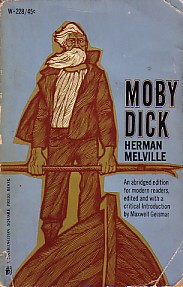
My interest in Moby-Dick, with or without the hyphen, continued nevertheless. As a slightly older child, I was a regular fixture in the children’s room of Oxford’s public library. I suspect that most editions of Moby-Dick are abridged versions, and the copy which I eagerly thumbed through during each visit was, naturally, no exception. Quite a bit of the material in the uncut Moby-Dick would have been lost on a youngster such as myself anyway. But what remained in that thick blue volume was enough to spur my interest onward.

I estimate my age at the time of my first excursion to the New Bedford Whaling Museum as being as young as eight, perhaps as old as ten. And, truth be told, I remember being vaguely disappointed. Perhaps my expectations of a whaling museum had been shaped by other museums which I had seen in cartoons, television programs, and movies. These museums had, among other, less interesting exhibits, many reconstructed skeletons of dinosaurs, very impressive to a pre-adolescent male. But the whaling museum had only one whale skeleton, that of a humpback whale. (They still have it, of course, but it’s somewhat overshadowed nowadays by the larger skeleton of a young blue whale which, like the humpback, is suspended from the ceiling.) Frankly, I only vaguely remember the museum’s other exhibits from that long-ago time.

A recent acquisition. I think this is the edition
I used to read in the Oxford library's Children's Room!

In the largish Lagoda Room, named after the half-scale replica of a typical whaling vessel contained within, the story began. The opening lines of the novel “Call me Ishmael,” and so on, were read by Assistant District Attorney Ray Veary, according to the programs with which we were supplied. These programs listed all the scheduled readers, but there were also several “alternates,” those who would read if a listed reader didn’t show. At least one of these alternates was called upon to read three separate times during the course of the marathon.

Every ten minutes, for the most part, the reader was replaced by yet another reader. The event’s “big guns” were scheduled toward the beginning and end of the marathon. In addition to A.D.A. Veary, the first hour and a half featured appearances by New Bedford’s mayor, Frederick M. Kalisz, Mary K. Bercaw, current president of the Melville Society, and Peter Whittemore, the great-great grandson of Herman Melville himself. Closing readers included Anne Brengle, the NBWM’s executive director, Carl Cruz of the New Bedford Historical Society, and Representative Barney Frank.

After the first ninety minutes or so, we were taken from the museum to the Seamen’s Bethel across the street. There we were treated to a recreation of Father Mapple’s sermon from Moby-Dick. Father Mapple’s dialogue was read by the Rev. Edward Dufresne, while the appropriate surrounding narration was read by A.D.A. Veary, reprising his role as Ishmael.

A comic book adaptation of the 1957 film.

Those who have seen the 1957 film of Moby Dick, starring Gregory Peck as the tortured Captain Ahab, and featuring Orson Welles as Father Mapple, will no doubt remember the impressive pulpit of the whaleman’s chapel, shaped like the prow of a ship. A somewhat less imposing version of that podium decorates the Seaman’s Bethel today, and even that is an after-thought. The ship’s-bow pulpit sprang from Melville’s imagination, and the Hollywood film embraced the attendant visual. However, the actual rostrum of the chapel was rather pedestrian. After having seen the film, visitors wondered why, and so, a somewhat more modest version of the movie’s pulpit was constructed. It was originally planned to be temporary, until a better version was built, but the visitors seemed satisfied, and that is the pulpit which stands today.

After the church service segment of the novel had been completed, we all returned to the museum. This time we were seated in the Jacobs Family Gallery. Here is where the two whale skeletons mentioned earlier are displayed, so those of us who stayed for the reading either sat near, or underneath, the remains of these two underwater mammals.

With the exception of an entertaining little skit (which Melville had actually written like a play-within-a-novel) performed in the museum’s theater at roughly 8 p.m. Saturday, the rest of the readings were held in the Jacobs Family Gallery.

 This was purchased a few years ago, when I went to the museum for the
second time. Another visit, another postcard. Thus continues the tradition!

2004’s eighth annual Moby-Dick Marathon turned out to be my third trip to the museum. Roughly five or six years ago, I went there with my godson Evan. I was honestly not prepared to have to defend the concept of “whaling” itself, from an historical perspective. At the time of my initial visit, I was a boy who thought nothing of these old-time sailors getting into their boats for the purpose of chasing and killing the whales needed to provide much of the world with oil for their lamps, as well as the raw material for everything from candles to hoop skirts. All young Evan could conceive was that these whalers were getting into their boats to kill whales. He couldn’t understand the apparent cruelty of the whole whaling experience. I tried to explain the bygone necessity of what we supposedly enlightened souls in these politically-correct, modern times would view as wholesale slaughter. I confess that I couldn’t completely justify the carnage to him, nor even, at that point, to myself.

Other than the 260-page "young readers" version, this 399-page paperback
was the only copy of the novel which I owned before the Marathon.

Those of you who only know of Moby-Dick’s bare-bones plot, i.e., a mad captain, Ahab by name, sacrificing all for the sake of revenging himself upon the whale which took off Ahab’s leg, are missing several facets of the story. The novel contains that story, true, but so much more as well. Melville gives more detail on whales and whaling than most modern readers would find necessary. He admittedly digresses from the main plot on a few occasions. And surprisingly, there is a lot more humor in the novel than one would suspect.

Those who find the book to be “boring” need to take the writing styles of 150 years ago into account, however. Poring through a 600-page volume published in 1851 is not the same as reading a modern Stephen King novel of the same length. Also, if I may make just one comparison, Melville’s work wasn’t even as accessible to the average reader as someone like Charles Dickens, whose writings, recognized as classic by today’s scholars, were originally written and serialized for the common man. For lack of a better way to put it, Dickens was writing the mid-1800s’ version of soap operas! Melville was not.

The museum supplied the late-night attendees with chowder, snacks, and coffee. Plenty of coffee! I lost count of my own caffeine intake after six cups.

While several of the readers and spectators were from New Bedford, participants came from as far away as Wisconsin. The youngest reader was Spencer Ross-Rose, an eight-year-old from Rehoboth. The eldest? Hard to say, although I would guess that a handful of Melville aficionados were in their eighties.

At the 2003 Moby-Dick Marathon, just over 700 people attended during the course of the reading. This year, over 1,000 people attended. The event’s organizers opined that the large increase was due to publicity and the fact that January 3rd and 4th fell on a Saturday and a Sunday this year. Last year, 20 people lasted for the entire 25½ hours. This year, the total who stayed from beginning to end was 25.

I was one of that 25. For my persistence, I received a deluxe, unabridged paperback version of the novel to which a curious collection of budding literati had devoted a weekend. This was a special 150th anniversary edition, published in 2001. When being handed my little trophy, I couldn’t resist asking, “Could I have a different book? I already know how this one ends.”

Third visit, third postcard.

Until receiving my prize at the marathon’s end, the only copy of Moby-Dick which I had owned was a small paperback copy, edited down to roughly 400 pages. Sometime around midnight on the Friday night before my Saturday journey to New Bedford, I held this shortened version in my hand and silently wondered what section I’d be reading. I did some quick mental calculations. I was scheduled to read at 3:30 a.m. Sunday, a little more than halfway through the marathon. Keeping in mind that it was all-too-possible that the 10-minute passage I’d actually be called upon to read might not even be in my abridged version, I opened the book at a point slightly beyond the 200-page mark.

I was immediately plunged into an earlier time. I rode with the crew of the Pequod as they set out to capture and kill a whale. But this section didn’t glorify the slaughter. As I read, it became apparent that the whale they pursued was old, infirm, and terrified. He was blind, and only had one flipper. “For all his old age, and his one arm, and his blind eyes, he must die the death and be murdered, in order to light the gay bridals and other merry-makings of men,” writes Melville, touching us with his description of how this besieged beast suffers. “For, by this time, so spent was he by loss of blood, that he helplessly rolled away from the wreck he had made; lay panting on his side, impotently flapped with his stumped fin, then over and over slowly revolved like a waning world; turned up the white secrets of his belly; lay like a log, and died. It was most piteous, that last expiring spout.”

I stood there that night, book in hand, thinking about how much I would like to recite that portion aloud if given the chance. Even as I thought that, I realized that the actual chances of that happening were slim. I’d opened the book at random. Plus, as mentioned earlier, there were over 200 pages of story which didn’t even exist in my paperback copy. I could be called upon to read from something I didn’t even own yet, as such.

Remarkably, however, I was assigned that very section of that very same chapter! I was able to read the tale of the old whale’s pitiful death, injecting a proper amount of emotion into the recitation. I can only hope I did it justice.

Best of all, I somehow feel that, in reading from this particular segment, I was able to successfully bridge the gap from a long-gone lifestyle to a little boy who shook his head in bewilderment and asked, “Why?” And my only answer, then as now, is that we really have no answers.

 My trophy, earned in 25½ hours.

Thanks for your time.

In Search of the White Whale!

 Yep, January 3 & 4, 2004. You missed it; I didn't.

Here's an article originally published in a mid-January, 2004, issue of the The Patriot, a Webster, Massachusetts newspaper. ("Oxford" refers to Oxford, Massachusetts, where I lived for over 15 years, during my so-called "formative" period.)

The whale from Pleasure Island's Moby Dick Hunt. I may never know
if my parents brought me there to indulge my youthful fascination for
Moby Dick, or if my obsession began after viewing the beast!

To call the weekend of January 3rd and 4th the culmination of a childhood preoccupation (I hesitate to write “obsession.”) may be phrasing it a bit too strongly, but that’s certainly how it felt to me.

On January 3rd, 1841, the Fairhaven Ship Acushnet sailed out of the New Bedford, Massachusetts harbor. The Acushnet’s crew included a young sailor named Herman Melville, who roughly ten years later published what is arguably the greatest American novel. I say “arguably.” Ken Kesey’s list of the ten best American novels (from The Book of Lists #2) gives Moby-Dick the #1 spot. However, the original Book of Lists includes Moby-Dick as one of “The 15 Most Boring Classics.”

One hundred and sixty-three years later to the day, a good-sized crowd of literary enthusiasts, myself included, gathered in the Lagoda Room of the New Bedford Whaling Museum in order to begin reading this novel aloud, non-stop, in mostly ten-minute increments. This innocent project would end up taking a little over twenty-five hours. Such is and was necessary for a book with a page count exceeding 600, especially considering the labyrinthine writing style common to much of the 19th century’s offerings.

The museum as it looks today!

Readers and spectators alike knew in advance that the reading would take that long, of course. Advance publicity for the event made it plain, which was easy enough for the event’s organizers, as it had been successfully attempted seven times before.

 The museum as it looked when I first visited.

 A postcard I bought when I first visited the New Bedford Whaling Museum
in the mid-1960s. I didn't know it then, but I'd started a tradition!

I don’t recall precisely when and how I first became aware of the epic tome Herman Melville entitled Moby-DickorThe Whale. (That hyphen in Moby-Dick, curiously enough, is present only in the title of the book. Every reference to the whale in the text of the novel itself omits it.) It may have become ingrained in my six or seven year old mind when my parents took my older sister and myself to Wakefield, Massachusetts, sometime circa 1962. The trip to Wakefield was to visit a theme park known as Pleasure Island, a relatively short-lived pretender to the Disneyland throne.

However, Pleasure Island’s mascot, as it were, was not a falsetto-voiced, anthropomorphic mouse and his cartoon cohorts. Pleasure Island’s mascot was Moby Dick himself. Well, a replica, anyway. The park even offered the “Moby Dick Hunt,” a leisurely boat ride which was marginally “threatened” by the eventual appearance of a scaled-down, robotic version of the legendary great white whale. Actually, the cut-rate Leviathan in question was a dingy yellow, rather than white, and even at my tender age, I could tell that the mechanical sea creature needed a proper cleaning.

My interest in Moby-Dick, with or without the hyphen, continued nevertheless. As a slightly older child, I was a regular fixture in the children’s room of Oxford’s public library. I suspect that most editions of Moby-Dick are abridged versions, and the copy which I eagerly thumbed through during each visit was, naturally, no exception. Quite a bit of the material in the uncut Moby-Dick would have been lost on a youngster such as myself anyway. But what remained in that thick blue volume was enough to spur my interest onward.

I estimate my age at the time of my first excursion to the New Bedford Whaling Museum as being as young as eight, perhaps as old as ten. And, truth be told, I remember being vaguely disappointed. Perhaps my expectations of a whaling museum had been shaped by other museums which I had seen in cartoons, television programs, and movies. These museums had, among other, less interesting exhibits, many reconstructed skeletons of dinosaurs, very impressive to a pre-adolescent male. But the whaling museum had only one whale skeleton, that of a humpback whale. (They still have it, of course, but it’s somewhat overshadowed nowadays by the larger skeleton of a young blue whale which, like the humpback, is suspended from the ceiling.) Frankly, I only vaguely remember the museum’s other exhibits from that long-ago time.

A recent acquisition. I think this is the edition
I used to read in the Oxford library's Children's Room!

In the largish Lagoda Room, named after the half-scale replica of a typical whaling vessel contained within, the story began. The opening lines of the novel “Call me Ishmael,” and so on, were read by Assistant District Attorney Ray Veary, according to the programs with which we were supplied. These programs listed all the scheduled readers, but there were also several “alternates,” those who would read if a listed reader didn’t show. At least one of these alternates was called upon to read three separate times during the course of the marathon.

Every ten minutes, for the most part, the reader was replaced by yet another reader. The event’s “big guns” were scheduled toward the beginning and end of the marathon. In addition to A.D.A. Veary, the first hour and a half featured appearances by New Bedford’s mayor, Frederick M. Kalisz, Mary K. Bercaw, current president of the Melville Society, and Peter Whittemore, the great-great grandson of Herman Melville himself. Closing readers included Anne Brengle, the NBWM’s executive director, Carl Cruz of the New Bedford Historical Society, and Representative Barney Frank.

After the first ninety minutes or so, we were taken from the museum to the Seamen’s Bethel across the street. There we were treated to a recreation of Father Mapple’s sermon from Moby-Dick. Father Mapple’s dialogue was read by the Rev. Edward Dufresne, while the appropriate surrounding narration was read by A.D.A. Veary, reprising his role as Ishmael.

A comic book adaptation of the 1957 film.

Those who have seen the 1957 film of Moby Dick, starring Gregory Peck as the tortured Captain Ahab, and featuring Orson Welles as Father Mapple, will no doubt remember the impressive pulpit of the whaleman’s chapel, shaped like the prow of a ship. A somewhat less imposing version of that podium decorates the Seaman’s Bethel today, and even that is an after-thought. The ship’s-bow pulpit sprang from Melville’s imagination, and the Hollywood film embraced the attendant visual. However, the actual rostrum of the chapel was rather pedestrian. After having seen the film, visitors wondered why, and so, a somewhat more modest version of the movie’s pulpit was constructed. It was originally planned to be temporary, until a better version was built, but the visitors seemed satisfied, and that is the pulpit which stands today.

After the church service segment of the novel had been completed, we all returned to the museum. This time we were seated in the Jacobs Family Gallery. Here is where the two whale skeletons mentioned earlier are displayed, so those of us who stayed for the reading either sat near, or underneath, the remains of these two underwater mammals.

With the exception of an entertaining little skit (which Melville had actually written like a play-within-a-novel) performed in the museum’s theater at roughly 8 p.m. Saturday, the rest of the readings were held in the Jacobs Family Gallery.

 This was purchased a few years ago, when I went to the museum for the
second time. Another visit, another postcard. Thus continues the tradition!

2004’s eighth annual Moby-Dick Marathon turned out to be my third trip to the museum. Roughly five or six years ago, I went there with my godson Evan. I was honestly not prepared to have to defend the concept of “whaling” itself, from an historical perspective. At the time of my initial visit, I was a boy who thought nothing of these old-time sailors getting into their boats for the purpose of chasing and killing the whales needed to provide much of the world with oil for their lamps, as well as the raw material for everything from candles to hoop skirts. All young Evan could conceive was that these whalers were getting into their boats to kill whales. He couldn’t understand the apparent cruelty of the whole whaling experience. I tried to explain the bygone necessity of what we supposedly enlightened souls in these politically-correct, modern times would view as wholesale slaughter. I confess that I couldn’t completely justify the carnage to him, nor even, at that point, to myself.

Other than the 260-page "young readers" version, this 399-page paperback
was the only copy of the novel which I owned before the Marathon.

Those of you who only know of Moby-Dick’s bare-bones plot, i.e., a mad captain, Ahab by name, sacrificing all for the sake of revenging himself upon the whale which took off Ahab’s leg, are missing several facets of the story. The novel contains that story, true, but so much more as well. Melville gives more detail on whales and whaling than most modern readers would find necessary. He admittedly digresses from the main plot on a few occasions. And surprisingly, there is a lot more humor in the novel than one would suspect.

Those who find the book to be “boring” need to take the writing styles of 150 years ago into account, however. Poring through a 600-page volume published in 1851 is not the same as reading a modern Stephen King novel of the same length. Also, if I may make just one comparison, Melville’s work wasn’t even as accessible to the average reader as someone like Charles Dickens, whose writings, recognized as classic by today’s scholars, were originally written and serialized for the common man. For lack of a better way to put it, Dickens was writing the mid-1800s’ version of soap operas! Melville was not.

The museum supplied the late-night attendees with chowder, snacks, and coffee. Plenty of coffee! I lost count of my own caffeine intake after six cups.

While several of the readers and spectators were from New Bedford, participants came from as far away as Wisconsin. The youngest reader was Spencer Ross-Rose, an eight-year-old from Rehoboth. The eldest? Hard to say, although I would guess that a handful of Melville aficionados were in their eighties.

At the 2003 Moby-Dick Marathon, just over 700 people attended during the course of the reading. This year, over 1,000 people attended. The event’s organizers opined that the large increase was due to publicity and the fact that January 3rd and 4th fell on a Saturday and a Sunday this year. Last year, 20 people lasted for the entire 25½ hours. This year, the total who stayed from beginning to end was 25.

I was one of that 25. For my persistence, I received a deluxe, unabridged paperback version of the novel to which a curious collection of budding literati had devoted a weekend. This was a special 150th anniversary edition, published in 2001. When being handed my little trophy, I couldn’t resist asking, “Could I have a different book? I already know how this one ends.”

Third visit, third postcard.

Until receiving my prize at the marathon’s end, the only copy of Moby-Dick which I had owned was a small paperback copy, edited down to roughly 400 pages. Sometime around midnight on the Friday night before my Saturday journey to New Bedford, I held this shortened version in my hand and silently wondered what section I’d be reading. I did some quick mental calculations. I was scheduled to read at 3:30 a.m. Sunday, a little more than halfway through the marathon. Keeping in mind that it was all-too-possible that the 10-minute passage I’d actually be called upon to read might not even be in my abridged version, I opened the book at a point slightly beyond the 200-page mark.

I was immediately plunged into an earlier time. I rode with the crew of the Pequod as they set out to capture and kill a whale. But this section didn’t glorify the slaughter. As I read, it became apparent that the whale they pursued was old, infirm, and terrified. He was blind, and only had one flipper. “For all his old age, and his one arm, and his blind eyes, he must die the death and be murdered, in order to light the gay bridals and other merry-makings of men,” writes Melville, touching us with his description of how this besieged beast suffers. “For, by this time, so spent was he by loss of blood, that he helplessly rolled away from the wreck he had made; lay panting on his side, impotently flapped with his stumped fin, then over and over slowly revolved like a waning world; turned up the white secrets of his belly; lay like a log, and died. It was most piteous, that last expiring spout.”

I stood there that night, book in hand, thinking about how much I would like to recite that portion aloud if given the chance. Even as I thought that, I realized that the actual chances of that happening were slim. I’d opened the book at random. Plus, as mentioned earlier, there were over 200 pages of story which didn’t even exist in my paperback copy. I could be called upon to read from something I didn’t even own yet, as such.

Remarkably, however, I was assigned that very section of that very same chapter! I was able to read the tale of the old whale’s pitiful death, injecting a proper amount of emotion into the recitation. I can only hope I did it justice.

Best of all, I somehow feel that, in reading from this particular segment, I was able to successfully bridge the gap from a long-gone lifestyle to a little boy who shook his head in bewilderment and asked, “Why?” And my only answer, then as now, is that we really have no answers.

 My trophy, earned in 25½ hours.

Thanks for your time.

Monday, October 20, 2008

"The Curse of the Cat People" (A Movie Review)

This week's entry pretty much speaks for itself. It was published in an arts & literary magazine called Nights and Days.


-->
From Review to Rant(?)
a kinda/sorta movie review by David M. Lynch
(entire contents copyright © 2003 David M. Lynch)

A few weeks ago, when the editor of Nights & Days asked me if I’d be interested in writing a movie review -- of all things! -- I had to make two decisions, PDQ:
  1. Should I say “yes” or “no?” Obviously, I said “yes.”
  2. Should the movie that I review be an older film (which would be my preference) or a new film (relatively few of which, frankly, interest me)? Well, being the self-centered S.O.B. that I am, #2 ended up being as much of a no-brainer for me as #1 was (after the fact, anyway) for you.

Generally speaking, those writers who review the current theatrical and/or DVD/VHS offerings do so with two purposes in mind:
  1. They wish to tell you whether or not you’ll be wasting your time sitting down long enough to view the film in its entirety, and
  2. They want to make a living by giving such advice.

In my case, the second scenario is doubtful to the point of being laughable. Therefore, ignoring what I said earlier about how self-centered I am, be assured that the following review is being written with your best interests at heart!

(For my next lie… )

Negativity comes naturally to me. I could have taken the easy way out and found some suitably odious piece of cinematic schlock to review. Lord knows, there’s enough trash out there, new and old, just waiting for an attack from my own poison pen (Well, I’m actually typing on the keyboard of my personal computer, as opposed to literally writing anything with a pen or pencil, but “poison PC,” however alliterative, doesn’t sound anywhere near as lofty, traditional, and pretentious, does it?). But I decided instead to deal with a film I could recommend with a clear conscience, a 1944 psychological thriller called The Curse of the Cat People.

(“Finally, forty-seven pages into the so-called review, the long-winded mofo tells us the name of the movie!”)

You may or may not agree with the so-called “auteur theory”[1], that annoying little postulation which is responsible for that equally annoying credit in so many movies, “A Film by [insert incredibly self-important director’s name here].”

Yeah, right. Let’s ignore the other 8,000,000 or so people who slaved on the same flick, shall we?

One of my primary arguments against any proposal which claims that the director’s influence on a film makes the end product completely his (or hers) is that the influence of (for example) a strong writer (one whose work is not subsequently emasculated by re-writes or other studio shenanigans, that is), or even an overpowering cinematographer or film editor, can keep the completed film from being the vision of any one person.

So, here’s my view: Given the circumstances behind a film’s history, from inception to final cut, a director… or a writer… or a cinematographer… or an editor… or even -- to name one particular gentleman whom I’ll eventually praise in this review -- a producer can put his/her indelible stamp on a motion picture.

And that brings us to producer Val Lewton, and The Curse of the Cat People.

(Ummm… You do remember The Curse of the Cat People, don’t you? This is an article about The Curse of the Cat People.[2])

The Curse of the Cat People was the 1944 sequel to 1942’s Cat People. But here I must once again digress by briefly describing Cat People itself.

If you’re not familiar with the 1942 original released by RKO, maybe you saw the 1982 remake, directed by Paul Schrader? The main differences -- of which there are several -- in this “update” were an incest sub-plot, one scene of light bondage & implied bestiality, and nude scenes by both Nastassia Kinski[3] (in her prime) and (believe it or not) Annette O’Toole. In other words, this version showed a lot more flesh than fur. Fun for the entire family! It also starred Malcolm McDowell (before he started looking like a cross between Sting and W.C. Fields) and John Heard (one of the most underrated actors since Kurt Russell).

Well, if you know the 1982 version, ignore it for the remainder of this review. Although any movie which features David Bowie on its soundtrack and has a panther tear an arm off of Ed Begley, Jr. can’t be all bad!

The original was a lot moodier, and a lot less bloody. It concerned -- and I’ll try to be uncharacteristically brief, here -- the romance between Serbian immigrant Irena (and that’s pronounced “Ee-ray-nah,” not “Eye-ree-nah”) Dubrovna and a gent named Oliver Reed (no relation at all to the he-man actor named Oliver Reed, who shuffled off this mortal coil a few years ago). Said romance progressed to an eventual marriage, despite the fact that Irena had a family secret. Her “family secret” was that whenever those of Irena’s bloodline were kissed, to say nothing of moments of… ummm… “extreme passion,” shall we say, they would supposedly (Yes, I said “supposedly.” Keep that in mind, please; I’ll reference it later.) turn into panthers.

Yup, you read that correctly.

Anyway, poor ol’ stupid Oliver not only married a woman he’d never even kissed, but quickly discovered that he shouldn’t expect any kisses – never mind anything more – after the wedding, either. Ever. (Can you say, “Sucks to be him,” boys and girls? Sure ya can.) Eventually, he becomes attracted to a female co-worker, Alice. Surprise, surprise. (There’s a very unfortunate, semi-misogynistic lesson there, ladies.)

Damn, do these mixed marriages ever work?

Unfortunately for the exotically beautiful Irena (SPOILER WARNING, but I’ll spare you the minute details, at least), being a horror film and all, this story does not end happily. After doing away with a libidinous psychologist (who’s been brought in by hubbie Oliver, who is so mired in the mundane that he just knows Irena is delusional), Panther/Irena (who’s also transformed by jealousy and anger, conveniently enough) goes after Alice. Alice survives, but Irena meets a predictably violent end. Bouncing back all too quickly for my tastes, Oliver winds up with Alice, who’s perfect for him (Boring with a capital “B,” in other words!).

The movie succeeded well enough for RKO to demand a sequel from producer Lewton. But Lewton didn’t want to do anything so predictable.

Another quasi-diversion, here. Val Lewton was one of those producers whom I referred to earlier, one who usually had a knack for putting together creative personnel (writers[4], directors, cinematographers, etc.) who could deliver a film which had Lewton’s own stylistic imprint upon it. Lewton loved dark, atmospheric worlds in which his characters could live -- or not live -- their lives. He preferred to let the viewers’ imaginations fill in the more violent aspects of his storylines (although admittedly, budgetary considerations may have occasionally been a factor).

Besides Cat People and its sequel, Lewton produced such minor classics as I Walked with a Zombie (1943; really good & really moody; stupid title) and The Leopard Man (also 1943; The Leopard Man, while not a great film, has one of the most chilling scenes in a movie of that period. I won’t spoil it. I suggest you find the blasted film, and after viewing it, you’ll know which scene I’m talking about!) He specialized in a more psychological form of terror. Lucky for him he never lived to see the rise of the “splatter films.”

Lewton didn’t care to simply re-hash his earlier effort when he made The Curse of the Cat People. (“You do remember The Curse of the Cat People, don’t you?” he said again. “This is an article about The Curse of the Cat People.”) Possibly he was still irked by the fact that RKO had, as legend has it, inserted one or two scenes in Cat People which “proved” that Irena had indeed become the cinematic version of Catwoman. Reportedly, Lewton’s original version left us wondering if Irena was really a supernatural creature, or (as husband Oliver believed) a certifiable nutball (which is why I made my earlier comment about Irena and her relatives supposedly becoming panthers).

Lewton assembled three of the original cast members (Simone Simon as Irena, Kent Smith as Oliver, and Jane Randolph as Alice) to reprise their roles, and went off on an extreme tangent from there.

As the story unfolds, we learn that Oliver and Alice have married and have a little girl, Amy, an absolutely gorgeous little child (and I’m not one of those people who automatically fawn over children) with blonde hair, and eyes that simply must be baby blue (This is a black-and-white film…)! They also have a butler, Edward (played by an actor named -- I swear -- Sir Lancelot) whose main purpose seems to be patronizing the child.

Amy is a dreamer, caught up in her own world much of the time. Her schoolmates consider her to be strange, and matters aren’t helped by Amy’s mishandling of the invitations to her own birthday party: In the Reeds’ backyard, y’see, is a large tree. When Amy was younger, Oliver had told her that it was a “magic mailbox.” Guess where the invitations to the party wound up? Terrific; one more reason for the kids to dislike little Amy; as far as they knew, virtually none of them were invited to her party!

Early in this nifty little flick, Oliver starts to really tick me off, by the way. His main talent as a father -- if you can call it that -- seems to be sending conflicting messages to his daughter. As in Cat People, he has nothing but scorn for almost anything showing imagination (although he himself is an artist of sorts, a ship architect, and enjoys building model ships as well). He evidently expects Amy to bypass her childhood fancies and “grow up.” (The term is mine, and not Oliver’s, but it’s quite appropriate to describe his attitude.)

In simpler terms, Oliver is a jerk. (Hey, what did you expect a contributor to a magazine like this to say about someone with a creativity-dampening attitude like Oliver’s?)

Some father! First, he instills a sense of wonder and magic in a little girl’s heart by coming up with something as nifty and inspired as a “magic mailbox,” and then figuratively stomps on that same heart a couple of years later by deriding Amy for believing such nonsense! But tell me something, Ollie, if a small child can’t trust and believe her parents, whom can she trust, fer cryin’ out loud?!?

Jerk. Maybe Irena’s whole “cat people” concept was only a dodge, and this is the real reason why Irena wouldn’t “do the wild thing” with Oliver: She knew he’d stink as a Dad! Why tempt fate by bearing his child?!?

So. After Amy shows Oliver where she “mailed” the invitations, they go back inside the house to have her party with just the immediate family, plus the ever-annoying Edward. They bring out the cake. And of course, Amy is told to blow out out the candles and make a wish.

Oops. So much for reality versus fantasy. But that’s a good kind of make-believe, they tell Amy in so many words! Why, I oughtta…!

It gets even worse as the story progresses. Anyone with half a heart (like myself – half a heart, that is) has no choice but to feel sorry for Amy. Her father’s an uptight Vulcan wannabe, her mother’s an all-but-ineffectual “little woman” to her “lord & master” Oliver, and Edward… Well, Edward just gives me the creeps.

All Amy wants is a friend. And in short order, she gets not one, but two.

The first is Julia Farren, the spooky old lady who lives in the nearby mansion. Julia was an acclaimed actress in her youth, one who seems to have been “courted” by suitors all over the world. Somewhere along the way, she produced a daughter, Barbara.

Barbara is a shifty-looking, slit-eyed chienne who immediately resents Amy’s friendship with her mother. And dangerously so. But you can’t totally blame Barbara, since Julia claims Barbara is not her daughter (She says the “real” Barbara died as a child.), and constantly refers to her as “that woman,” and terms which are equally endearing.

Julia’s theatricality strikes a positive chord with Amy, although Julia’s little monologue about the Headless Horseman will probably unnerve anyone who’s even a bit impressionable. It also sets up a great moment later on, too! Naturally, Amy’s friendship with such a woman doesn’t completely please Amy’s parents, or creepy Edward.

But, as I stated above, it gets worse. Amy’s other friend, who “magically” appears to her one night, is Irena herself. Yes, Irena, Oliver’s first wife, the family secret which Oliver and Alice have kept from little Amy.

It’s here that the brilliance of Lewton’s creative crew becomes apparent. In Cat People as it was originally envisioned, we were never supposed to know for sure whether or not Irena’s transformations were real. And here, we’re not 100% sure that Irena is not a product of Amy’s imaginings. However, if there is no real ghost, how does Amy know what Irena looks and sounds like? Amy never met her, since Irena died before Amy’s birth, nor has she ever seen a photo of Irena, although Oliver is still hiding a couple from Alice. And how does Amy learn the haunting tune which Irena used to hum?

The climax of the story coincides with the Christmas season. In fact, if the first issue of Nights and Days had been planned for July, rather than August, I would have sneakily suggested that you locate this movie as a feature for a demented “Christmas in July” gathering. As it is, however, you may have to search until the real Christmas season in order to find it!

From this point on, I’ll leave out a lot of detail (because it’s my genuine hope that you will indeed seek out this movie so you can view it for yourself), but you can probably guess Oliver’s reaction once he discovers who Amy’s new “imaginary friend” is.

Then again, maybe you can’t guess the extent of his reaction. He takes the kid to her bedroom upstairs (and mercifully, off-camera) to “punish” her. He has, to paraphrase Alice (because I don’t have the videotape cued up), never punished her “that way” before.

When it comes to corporal punishment, I’m somewhere in-between the modern view that says you should never strike a child, and those flaming idiots who think it’s okay to beat on a kid because you’re a little bit drunk and/or you just don’t like his face. Under extreme circumstances, I can justify it somewhat; for instance, there’s a scene in the 1936 classic, These Two, where the trouble-making, life-wrecking little brat gets a slap in the face from Margaret Hamilton (later to play the Wicked Witch of the West) that makes me want to stand up and cheer.

But for Oliver to spank little Amy for the “offense” of… well, for being a child, for “lying” about the friend which Oliver (understandably) thinks is imaginary? No, there’s no excuse. And that’s the aspect of this movie that keeps bothering me as I write this review. That’s the aspect that sidetracks this simple review into a rant. I can’t escape the bitter thoughts about Oliver, the Always-Right. Oliver, the Contradictory. Oliver, the Parent-Who-Needs-to-Be-On-a-Freaking-Leash!

Oliver the Jerk.

I don’t blame the kid for sneaking out of the house and into the cold winter evening. And that’s just what she does, while Oliver and Alice are downstairs, being entertained by Hollywood’s most professional “neighborhood carolers” ever (These folks really represent the crème de la crème of a supposedly thrown-together group! They all have perfect pitch, and they sing the most obscure requests in multi-layered harmonies!). Amy’s disappearance leads to the sudden -- and unconvincing -- “redemption” of that self-righteous prig, Oliver, as well as the eerie and unsettling resolutions of all plot threads…

And no, I won’t spoil those. Instead, I strongly suggest you find this film. Even if you’ve never seen Cat People. Even if you never want to see Cat People. You don’t have to see it, although I do recommend it, as well; Curse of the Cat People stands on its own. And I think it’s one of those remarkably few sequels -- although “sequel” is really a misnomer, here -- that outshines the original.

I think you’ll enjoy it, if you can avoid focusing to the point of obsessing (as I did) on Oliver’s pig-headedness!

Thanks for your time.


[1]If you need and would like a nice, neat, and relatively short definition/explanation of the auteur theory, here’s a web page for you to visit: http://www.everything2.org/index.pl?node=auteur%20theory; If you’re looking for a more elaborate definition and history, something, shall we say, in a more scholarly vein, here you go: http://comm2.fsu.edu/programs/comm/film/spintro.htm. However, if you’d prefer something which resembles what I myself might have written (but only after dropping one or two 0.5 mg tablets of lorazepam), try http://www.filmjerk.com/nuke/article47.html. Happy hunting, and don’t say I never gave you anything!
[2] With apologies to Arlo Guthrie and “Alice’s Restaurant,” of course.
[3] Or was she spelling it Nastassja that week? Check her listing at http://us.imdb.com/Name?Kinski,+Nastassja and you’ll see what I mean!
[4]I should mention that Lewton was the credited co-writer of all four films mentioned in this paragraph!

Now, as for next time.... I'm not sure, yet. I may fill this space with the first of hopefully three chapters about my comic book concept, Aero. Or instead, I may share the story of the most dangerous thing I ever did in the name of "research" for my writing.

Or. I. May. Eat. Something. Strange. Again.

Or... not.

Meet me here next Monday, and we'll both find out, okay?

Related Posts Plugin for WordPress, Blogger...