If you haven't read Part One of "My Keys to the Kingdom" yet, please go read it now
. I'll wait. I also suggest that you take a leave of absence from your job, and make arrangements to have your next few meals delivered.
This is a lonnnnng
one.
Comic books -- more than any Whitman
Little Golden Books, or any
other "kiddie" books or magazines to which I was exposed as a young foxling -- taught me to read. And I'm not overestimating their importance when I say that they also instilled in me a
love for reading in general, to the point where I became -- and for the most part, remain -- a voracious reader.
My parents, thankfully, were open-minded enough to accept and even welcome my comic book habit. How could they
not, when they saw what the comics
did for me?
I would encounter a character like Adolf Hitler in an issue of
Sgt. Fury and his Howling Commandos, and follow up by going to my family's 1962 edition of
The World Book Encyclopedia for even
more information on "that Hitler guy."
I would read about Marvel Comics' re-worked versions of Norse Mythology in
Journey into Mystery -- later re-titled
The Mighty Thor -- and rush once
again to the
World Book to read more about the "real" Thor, Loki, Odin, and Balder the Brave.
I daresay that comics influenced my earliest attempts at
writing, as well. I shudder to think of this
now, but some of my very first stories consisted of cutting out select panels (
sans dialogue) from various comics, and then arranging them in a neat stack which told all-
new tales of my
own design!
But of all the comic publishers whose work I devoured, it was the early Marvels that influenced me the most. When I was seven, or eight, or even
nine, the DC Comics which I read -- and admittedly enjoyed -- seemed aimed toward kids my age, or slightly above. The
Marvel titles seemed to be targeting a
much older crowd, say, maybe twelve, or even fourteen...!
Analyzing the writings of Stan Lee and what I learned from them -- both
personally and in terms of (capital "W")
"Writing" -- would fill a book, or several. And others have already written such books. The same would go for the explosive, impressionistic artwork of Jack Kirby (which is
not to slight any of the
other Marvel artists who illustrated Marvel's stories).
Therefore, I'm not going to go on and on and
on about selected Marvel characters or storylines here. (Those of you who've read my endless praises of Captain America in my last post and elsewhere may be saying "Ohhh,
now he says that!") Don't forget, this two-part post began, and will attempt to remain -- about Jack Kirby.
At roughly the same time as I was learning that long before DC's Justice League of America, there was a Justice
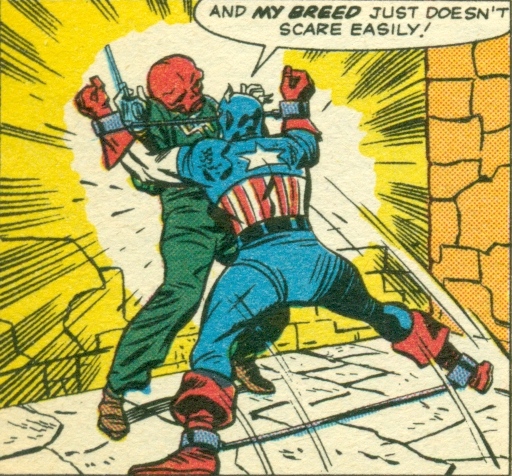
Society of America -- and that comic books had been around at least twenty years before I started reading them -- I found out that Captain America had originally been published in the 1940s by Timely Comics, the forerunner of Marvel Comics.
And this Jack Kirby guy had drawn Captain America
then, too!
Geez! How old
was this guy? As old as my
dad was, I thought!
(Well... yeah. Pretty much. My dad was born in early September of 1916, and as you know, Jacob Kurtzberg arrived roughly 51 weeks later!)
Starting in 1964, it turned out that Marvel was really nice to people like myself who'd missed the first year or two of what some now call the "Marvel Age." In their giant-sized annuals, Marvel reprinted a
lot of the early tales of the FF, Thor, Spider-Man... I was as excited by the
reprints as I was the
new material that began each annual. After all,
any story you haven't read before is a
new story, right? And as I stated last time, there sure as heck wasn't any way to get
back issues once all available friends and barber shops had been rifled!
Fantastic Four Annual #2 is one of my favorite annuals
ever, no lie! Not
one, but
two new stories featuring Dr. Doom (one of them a detailed origin)
and a reprint of his first appearance from
Fantastic Four #5.

And
this above-pictured little gem is
another of my all-time favorite annuals! This beauty reprinted the debut appearances of the heroes featured above... and more than
half the issue featured art by Jack Kirby.
Marvel Tales Annual #1 held
another treasure for the budding Marvelite: A two-page spread with photos of Stan Lee, most of Marvel's regular artists, and several inkers, letterers, and production people.
In 1966, I learned that the FF's Human Torch, Johnny Storm, was actually the second superhero by that name. The first was -- yep, you guessed it, fellow babies -- a Timely Comics character introduced in 1939.
(They were also nice enough to reprint
Fantastic Four #25 and #26 in that exciting annual. Finally, I got to read the
first part of that fabled two-parter!)
With the third issue of an all-reprint title called
Fantasy Masterpieces, Marvel began reprinting some of their Golden Age material, starting with the earliest
Captain America Comics tales, produced by Jack Kirby with his then-partner, Joe Simon.
I found the look of the artwork by a twenty-years-younger Kirby to be radically different, but nevertheless instilled with the same raw power.

As a little aside here, I must grudgingly admit that in 1966, even as I purchased issues #3, #4, and the subsequent issues of Fantasy Masterpieces, it never occurred to me that the following Harvey Comics issue of Simon & Kirby's Fighting American -- consisting of reprints from the 1950s -- was a product of the same team who'd done all those cool old Captain America stories!

(Maybe it would have helped if I'd bothered to read the damned credits or the text pages in that over-sized volume!)
* * * * *
Now let's jump ahead... about twenty years!
While working for a comic and collectibles store called
That's Entertainment in Worcester, Massachusetts, I'd gotten my feet wet as a comic book scripter, working on an amateur title called
Insect Man's Weird Tales. At about the same time, I had a conversation with my friend and then-employer
Paul Howley, the
owner of That's Entertainment, in which we discussed the possibility of licensing and publishing a comic book revival of a favorite TV show from our childhood,
The Man from U.N.C.L.E. (A more complete version of this story may be found
here.)
My writing partner Skip Simpson and I were in the process of re-working an unsold comic strip called Hawklad into what ultimately became a one-shot comic book called The Bird: Pan-Dimensional Victim of Circumstance. Skip and I were also working on a concept called Street Rats. But we put both of those projects on hold in order to plot and script the first and second issues of Entertainment Publishing's The Man from U.N.C.L.E. comic.
So, finally, at the age of 30 -- this was in late 1986, early 1987 -- I was a "comic pro." Well, more or less.
In the years since the height of my enthusiastic mid-1960s Marvelmania, Jack Kirby had left Marvel, and done some incredible work for DC Comics. He'd left DC and returned to Marvel. He'd left Marvel and done work for animated cartoons and the so-called "independent" comic publishers which started springing up in the late 1970s and early 1980s.
There was also a huge controversy at the time -- I'll spare you the gory details! -- over Marvel's "negotiations" with Kirby about whether or not he would get some of his now-valuable original art pages back. Industry pros were almost unanimously on Jack's side. Kirby and his wife Roz were seemingly everywhere in the comic fanzines as this situation escalated.
For totally unrelated reasons, I was also in the midst of buying Kirby back issues I'd missed the first time out. Mostly his 1970s DC and Marvel stuff.
So, with Kirby at the forefront of my mind for several reasons, I decided to contact him to tell him what an inspiration he'd been to me, and how he'd helped to steer me toward what I hoped would be a career. I mean, I knew I'd probably be, like, the eight-millionth person to do so. One more couldn't hurt, right?
On the inside front cover of Kirby's Captain Victory and the Galactic Rangers, published in 1981, a text section mentioned that Kirby lived in Thousand Oaks, California. Roughly five years later, I sat there wondering if he still lived there, and whether or not his phone number was unpublished.
I dialed Directory Assistance and asked for the number of Jack Kirby. Not knowing whether he'd ever changed his name legally, I was fully prepared to ask for the number of a "Jacob Kurtzberg," but that wasn't necessary.
When I finally got up the nerve to dial his number, the almost-legendary Roz Kirby answered. I tried to balance the eight-year-old comic fan inside of me with the "fellow comics professional" -- yeah, right -- which I hoped to someday become as I realized that Mrs. Kirby was politely "screening" the call. Shortly into our conversation, she commented that my voice sounded a bit odd, as if the connection were bad.
"Well, I'm calling from Massachusetts," I began.
"Oh, then I'd better let you talk to him!" she interjected.
When Mr. Kirby -- Jack -- got on the phone, I did my damnedest to sound cool, calm, and collected... in other words, like a freakin' adult... and I think I did fairly well.
The first thing I said was that I was rather surprised that his number wasn't unpublished, to which he matter-of-factly replied, "I don't hide from people."
The next fifteen minutes or so weren't awkward at all, surprisingly. I briefly mentioned The Man from U.N.C.L.E., told him how inspirational I'd found his work to be, how my research into comic history had resulted in my picking up a lot of the stuff he'd done during his career, how I wished him the best of luck with the ongoing "Marvel Art Controversy," and...
I swear, in those fifteen minutes I did let him do some of the talking, too!
I even asked him how to pronounce Mark Evanier's name! At the time, I wondered if it was a French name, pronounced "Eh-VAH-nee-yay," or something similar. Jack told me it was "EV-a-neer."
Finally, Jack mentioned that the long distance phone call must be costing me a lot of money, so he suggested that we say our good-byes. I'll never know if he was truly concerned about my phone bill -- which would be perfectly in character for Jack -- or if he figured "Okay, this guy seems harmless, but I have things to do."
And it really doesn't matter.
* * * * *
By early February of 1994, roughly seven years later, I had left That's Entertainment (amicably, in 1988). I was working part-time in a grocery-store bakery
and selling new & used comic books at a nearby flea market on Sundays. Every Friday morning, I traveled to the Boston-area warehouse of my comic book distributor to pick up that week's new comics and related stock.
Although the large roomful of merchandise in which the other comic dealers congregated was about as full of comic shop owners (or their employees) as usual, it seemed a lot quieter, for some strange reason. The guy who ran the warehouse,
"Jeep" Holland (a guy with an
extraordinary "backstory" who in his later years resembled "Comic Book Guy" from
The Simpsons), informed me that Jack Kirby had died the previous Sunday, February 6th.
I immediately understood the solemn mood in the dealers' room and the attached warehouse. It was like we'd all lost a member of the family.
This was a good five years before I'd ever ventured online. Therefore, I had no blog(s), but I
did distribute an irregularly-scheduled "publication" filled with comic book news and (naturally) my own "RantZ" called
Not Necessarily the Newsletter to my flea market customers.
I devoted the entirety of
NNtN's very next issue to a Kirby tribute which provided a seven-page summation of his professional history. It took twelve working hours. I worked largely from memory, being able to locate only a few items from my collection of "stuff" to aid my research on such short notice.
The eighth and final page was saved for an illustration. I didn't want to "waste" it.
Don't forget, this wasn't an online blog, so I couldn't just insert illustrations all along the way like I can nowadays. Even the computer I composed my newsletter on -- my sister's Mac II -- was only a glorified word processor! I had to photocopy the page with the picture I wanted, and
literally paste that photocopy into the middle of the text already printed out on my eighth page! Pain in the butt? Somewhat, yeah.
What, I wondered, could & should I use, out of all the material Kirby had drawn in his lifetime?
Twisted little s.o.b. that I am, I decided to use something that
hadn't been drawn
by Jack Kirby... but was
about him.
At the very start of his comic book career, Jack Kirby had worked for another comic book legend, Will Eisner (and his partner, Jerry Iger, in the "Eisner/Iger shop"). In Eisner's thinly disguised autobiographical 1986 graphic novel, The Dreamer, Eisner did a one-page tribute to "Jack King." And everybody knew who Jack King really was, of course!
That was the final page of my own Kirby tribute. And this was the only one of my newsletters which ever had a second printing, due to customer demand.
* * * * *
Finally, I'm going to wrap things up here with a special treat for my writing partner, Skip Simpson! Here's the first page of an unpublished adaptation by Kirby of the classic TV show, The Prisoner!
If Skip -- and anyone else -- wants to see the rest... click
here!
Thanks for your time... and your indulgence!